

A Compilation of Command Prompt Tips, Tricks & Cool Things You Can Do
Although Windows settings provide easy access for configuring about things, the Command Prompt -- elevated or otherwise -- can be indispensable in a number of scenarios, especially when yous know how to accept advantage of it.
Sometimes settings can be practical past typing a few characters instead of clicking through a series of menus, while other times in that location simply isn't any other way to perform an operation except with command lines.
We've compiled a list of things that you tin do in the Windows Control Prompt, including some commands everyone should know for general usage, more advanced ones for tweaking or troubleshooting your PC, as well equally bottom known and less practical Command Prompt features. Our list of tips and tricks below has been organized from briefest and most useful, to more than complex and risky...
Cease whatsoever command mid-performance
Since you might be testing some commands... pressing Ctrl + C will cancel a command that you've already entered and allow you lot to begin typing some other one, while typing cls will clear the electric current window of any commands that y'all've entered.
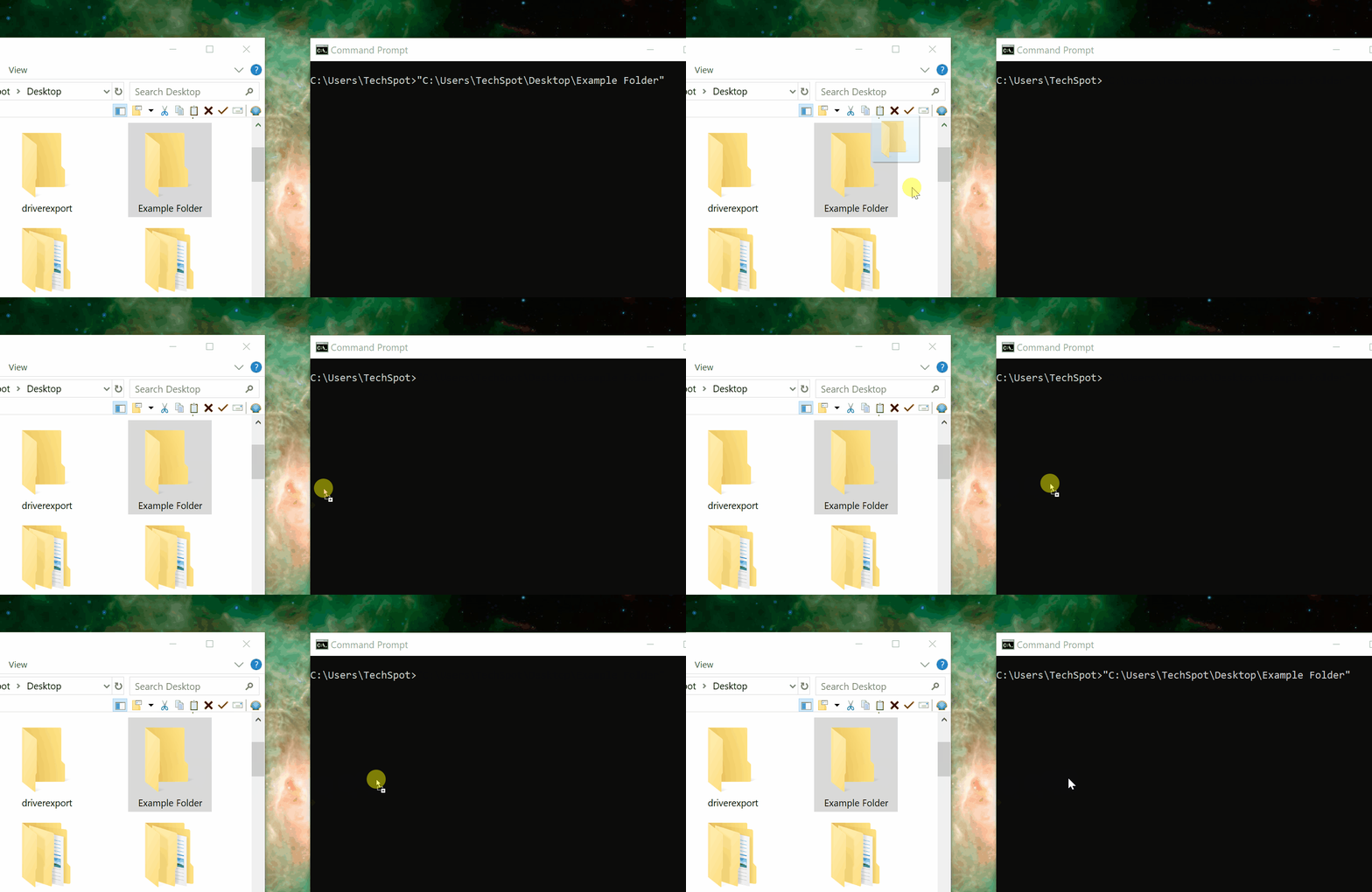
Drag and driblet folders to insert a directory path
Directory paths don't have to be typed in the beginning place. Aside from being able to copy/paste text and tab through directories, you can drag and drop a folder direct into the Command Prompt window to automatically insert the location.
Zoom in (and out)
The command prompt used to calibration pretty poorly and show very small-scale text, only now it'due south been modernized so y'all can zoom in simply like yous practice in a web browser. Use Ctrl + Mouse Wheel Up/Down to zoom in and out text.
Did you know there is a settings menu?
Right-click the title bar and open Properties for settings that include the ability to change your Command Prompt's font, layout and colors, also as options such as Quick Edit mode, which will automatically paste text from your clipboard when y'all right click in the window.
Bonus: You tin can also customize the text in the acme bar past typing title followed by the text that you desire (example: championship My title was pasted with Quick Edit mode).

Command Prompt keyboard shortcuts
Tapping the up and downwardly arrows on your keyboard will wheel through commands that you lot've previously entered. More than shortcuts:
Tab: When y'all're typing a folder path, tab volition auto-complete and cycle through directories
Ctrl + Grand: Enables Mark Mode which lets you lot move the cursor in all directions with the arrow keys
Ctrl + C or V: As of Windows 10, yous tin can copy and paste with Ctrl + C and V similar elsewhere around the OS
Ctrl + F: Likewise, Ctrl + F now lets y'all search for text in the Control Prompt
Ctrl + Shift + Scroll on your mouse: Increases or decreases the window transparency (+ and - keys piece of work too)
Alt + Enter: Enables total-screen mode with no championship bar displayed on peak (F11 likewise works like elsewhere in Windows)
Enter multiple commands at once
Adding && between commands will let you enter multiple lines at once to be executed in succession. Example:
tasklist && netstat -b
Meet every process running and connected
Entering tasklist command will list all of the processes running on your machine along with details such every bit their process identifier and memory usage, while netstat -b will generate a list of all the processes with an established network connection.

Listing every device driver on your PC
There are many ways to generate a list of drivers in the Command Prompt, here's one line that includes boosted information such as the status of a device and the folder location/file name of the associated driver:
driverquery /FO list /v
Output results to text file or clipboard
Yous tin can save the output of a command such as tasklist or driverquery to a new text file past adding > along with a directory and file name. Example:
driverquery > C:\Users\TechSpot\Desktop\output.txt
The role keys F1-F9 are also shortcuts
The function (F) keys on the top of your keyboard are also shortcuts that generally re-enter previous commands without retyping them.
- F1: Tapping or holding this key will retype the command that you lot just entered letter by letter.
- F2: Copies the current command up to a specified character.
- F3: Completely retypes the previous line that you entered.
- F4: The reverse of F2 -- auto-deletes up to a specified graphic symbol (your cursor must be in forepart of the text).
- F5: Retypes the previous command like F3 but lets you lot cycle dorsum through many lines in your command history.
- F6: Inserts Ctrl+Z (^Z) in the Command Prompt, which is an terminate-of-file indication (text after this is ignored)
- F7: Opens a listing of previously entered commands that you tin select from.
- F8: Works like F5 but doesn't finish at the end of your command history, cycles back to the start.
- F9: Lets you retype a previous command by entering a number associated with the line.
Use the Windows Terminal
The Windows Terminal was introduced in the more than recent version of Windows as is bachelor as a complimentary download from the Microsoft Store. The Terminal is a modernized command line tool that adds a tabbed interface in which you can open multiple command lines, but also the PowerShell, SSH connections and the Windows Subsystem for Linux (WSL), making it a very versatile choice for command line users.
The Windows Terminal is getting frequent updates and support for mod features such as GPU accelerated text rendering, which paves the fashion for icon and emoji support, as well every bit significantly faster text display.

Delete temporary files from your drive
Some of the temporary files on your bulldoze tin can be deleted with the following commands (/q runs the operation without a confirmation prompt, /f ignores the read-only attribute and forces deletion, /s deletes contents from all sub-folders):
- Delete temporary user files: del /q /f /s %temp%\*
- Delete temporary system files (requires admin rights): del /southward /q C:\Windows\temp\*
- ...Or run them together: del /q /f /s %temp%\* && del /due south /q C:\Windows\temp\*

If that didn't empty plenty storage, here are more temp folder locations, and we recently covered a bunch of ways to gratuitous upwards space on Windows, including Command Prompt methods to launch an advanced Deejay Cleanup tool and another to disable hibernation by deleting the characteristic's system file (hiberfil.sys).
Open the Windows on-screen keyboard
Entering osk into a Command Prompt opens Windows' on-screen keyboard which lets you click keys with your mouse instead of typing them.
Shutdown your PC at a certain time
The "shutdown" control tin can be used with a range of switches to shutdown, reboot and more, including the ability to force applications airtight, to brandish a message on shutdown, and to specify the number of seconds you lot'd like before the operation happens. Instance: shutdown -southward -t 3600 would shutdown your PC in i 60 minutes.
Create a Wi-Fi hotspot & Find your Wi-Fi password
If your network adapter supports the feature, you lot can configure your PC to be a wireless hotspot from the Command Prompt.
How to cheque if your hardware is capable: Enter netsh wlan show drivers and look for the line that reads "Hosted network support: Aye."

From there, yous can enable the hotspot with this command: netsh wlan ready hostednetwork mode=allow ssid=YOURSSID fundamental=YOURPASSWORD
Likewise enter this line to enable the hotspot: netsh wlan get-go hostednetwork (stop works as well) and you tin can check the status of your new hotspot by entering netsh wlan evidence hostednetwork.
You may also accept to navigate through some GUI menus to enable connectedness sharing (we couldn't find a style to practise this from the Command Prompt): Get to Network and Sharing > Alter adapter settings (Control Console\Network and Internet\Network Connections) and y'all should see the network adapters connected to your PC.
Right click the device that is connected to the Internet (non your new hotspot if that's listed) and open Properties. In the Sharing tab, check the box to "Let other network users to connect through this computer'south Internet connectedness."

Among other netsh commands, the feature can bear witness your Wi-Fi password by entering netsh WLAN show profile proper name= YOURPROFILE cardinal=clear (look under Security settings > Key Content).
This line tin delete a network profile yous're no longer using: netsh WLAN delete profile name= YOURPROFILE
Quick gear up commands for connection issues
Trouble with your connection? ipconfig has some go-to commands to resolve the event:

- ipconfig /release (Releases your currently issued local IP address)
- ipconfig /renew (Requests a new local IP accost)
- ipconfig /flushdns (Resets the contents of the DNS customer resolver cache)
For persistent issues with your connexion, there are some more elaborate commands that are worth trying. Annotation that you lot may have to reconfigure your network adapter etc. if you have manual settings, peculiarly when resetting TCP/IP and the Windows Firewall.
These commands require a reboot.
- netsh winsock reset (Resets the winsock catalog to its default state, removing layered service providers -- netsh winsock show itemize lists these items)
- netsh int ip reset all (Removes and reinstalls TCP/IP, rewriting a couple of associated registry keys)
- netsh advfirewall reset (Restores the Windows Firewall to default settings, deleting previously configured rules etc.)
- nbtstat -r (Purges the contents of the NetBIOS proper name cache and and then reloads the #PRE-tagged entries from the Lmhosts file)
- nbtstat -rr (Releases and and then refreshes NetBIOS names for the local calculator that is registered with WINS servers)

Quick set commands for kicking problems
Are you greeted with a message that reads "reboot and select proper boot device?" or "NTLDR is missing" when you plow on your PC? The method below has worked for usa to repair a Windows 8 machine and should be valid for other editions of Windows.
Note that these lines must be entered in a Command Prompt that is opened in a recovery environment from outside of your operating system, such equally from a bootable USB bulldoze with Windows 10 / Windows xi installation media.
- bootrec /fixmbr
- bootrec /fixboot
- bootrec /scanos
- bootrec /rebuildbcd

Although that sequence has worked for us in the past, we tested this on a virtual automobile by deleting the organisation reserved sectionalisation (where boot information is stored) and trying to restore the bootable country by entering those lines. Unfortunately, access was denied for bootrec /fixboot and we couldn't find a workaround, so Windows still couldn't load.
Notwithstanding, these bcdboot and bootsect commands worked to get Windows booting over again, even though we merely reformatted the system partition:
- bcdboot C:\Windows (Recreates the system partition files with those copied from C:\Windows. While this format works from within Windows, run into the note beneath nigh running this command from a recovery console outside of Windows).
- bootsect /nt60 SYS /mbr (Rewrites principal kick code on the organisation partition and updates your principal boot record)
*Note: If you lot are trying to run bcdboot C:\Windows from a recovery console exterior of your Windows installation (such as from the Windows eleven installation media), C:\Windows is probably D:\Windows (your operating system) while C:\ is probably your arrangement division (the boot info). Entering diskpart and so list vol will display drive volumes so you know what's what (blazon exit to close diskpart). To run the bcdboot operation from a recovery surroundings, you want something like this command: bcdboot D:\Windows /s C:\

Footnote...
Master Boot Tape - The first sector on the whole drive and contains a boot loader as well equally information about partitions on the drive.
Volume Boot Record (aka Partition Boot Sector/System Partition in MS terminology) - The first sector on a partition containing information to load an operation organisation.
Quick set up commands for repairing Windows
Even so can't boot into Windows? Experiencing blue screens or some other bug? The Os has built-in tools to browse for and replace decadent arrangement files:
- sfc /scannow (from inside Windows)
- sfc /scannow /offbootdir=D:\ /offwindir=D:\Windows (from outside Windows, such as from a recovery bulldoze)
A separate DISM command can browse the Windows component store for corrupt files and automatically repair them:
- DISM /Online /Cleanup-Paradigm /RestoreHealth (from inside Windows)
- DISM /Paradigm:D:\ /Cleanup-Image /RestoreHealth (from outside Windows)
Encrypt, compress or backup files
Files and folders can exist encrypted or compressed and and then unencrypted and decompressed with quick individual commands for each functioning -- make sure y'all change the target destination:
Encrypt a file or folder: cipher /e C:\Users\TechSpot\Desktop\Folder (here are more cipher commands -- /h applies a subconscious aspect)
Decrypt that file or binder: zilch /d C:\Users\TechSpot\Desktop\Folder
Compress a file or folder: meaty /c /s:C:\Users\TechSpot\Desktop\Binder
Decompress a file or folder: meaty /u /s:C:\Users\TechSpot\Desktop\Folder
You can create semi-incremental file backups using robocopy, though this is more involved than the previous commands.
There's a great Super User thread discussing the discipline where variants of the same command are recommended for having robocopy do basic file backups, copying files from one location to some other -- but only when changes take been fabricated.
Hither's the most suggested command (meet the link for an explanation on the options):
robocopy C:\source 1000:\destination /MIR /FFT /R:3 /W:10 /Z /NP /NDL
Generate reports nearly your arrangement
These reports are surprisingly detailed and may assist in understanding issues involving your system'south power consumption or wireless connectivity.

powercfg /energy (Generates a report about the energy efficiency of your organization -- the location of the written report is mentioned afterwards the command finishes)
powercfg /batteryreport (Generates a study with specifications for your battery also every bit stats and graphs most the history of your bombardment usage)
netsh wlan prove wlanreport (Generates a written report with specs for your wireless hardware along with information nearly your connection history)
Watch an ASCII version of Star Wars Episode IV
A diversity of sometime schoolhouse telnet services are still available, including the ability to watch Star Wars Episode IV.
Enter telnet towel.blinkenlights.nl into a Control Prompt for the motion picture to start (there'southward no audio).
Note: If the command isn't recognized, yous might have to enable telnet. Search Start or the Control Panel for "Turn Windows features on or off" and check the box next to Telnet (click Ok...).

More places yous can go via telnet:
- telnet towel.blinkenlights.nl 666 (a "bastard operator from hell" alibi generator)
- telnet telnet.wmflabs.org (Wikimedia)
- telnet rainmaker.wunderground.com (Weather Underground)
- telnet aardmud.org 4000 (Aardwolf)

- telnet achaea.com 23 (Achaea)
- telnet ateraan.com 4002 (New Worlds - Ateraan)
- telnet avalon-rpg.com 23 (Avalon: The Fable Lives)
- telnet batmud.bat.org 23 (BatMUD)

- telnet eclipse.cs.pdx.edu 7680 (New Moon)
- telnet forgottenkingdoms.org 4000 (Forgotten Kingdoms)
- telnet freechess.org 5000 (Free Chess)
- telnet igormud.org 1701 (IgorMUD)
- telnet lord.stabs.org 23 (Legend of the Scarlet Dragon)
- telnet mush.shelteringcolorado.com 2601 (Sheltering Heaven: Colorado by Nighttime)
- telnet zombiemud.org 23 (Zombie MUD)
Note: This feature was originally published on Oct 2022. We have revised some of its content and bumped it due to its old school nature, equally office of our #ThrowbackThursday initiative.
More Useful Tips
- Rundown of Must-Take Portable Apps
- How to Encrypt Files, Folders and Drives on Windows
- 21 Programs to Analyze and Benchmark Your Hardware
- "Run as Administrator": What Does It Mean?

Source: https://www.techspot.com/guides/1724-command-prompt-what-you-can-do/
Posted by: hunnicuttthessis1975.blogspot.com
0 Response to "A Compilation of Command Prompt Tips, Tricks & Cool Things You Can Do"
Post a Comment